Putin's options after the war has stalled

In this video, I discuss what Putin can do to turn the war around. Russia is pretty much stuck, and it seems inevitable that Putin will need to do something. But there are multiple ways he could go, and I think it's important that we start thinking about his options.
Watch the video here or read the transcript below.
Best,
Anders
Transcript:
The war is not going particularly well for Russia right now, they are no longer making progress on the front line, and Ukraine is having more and more success with deep strikes that hurt the Russian economy. The recipe they've been following for the last two years that has ensured progress on the front line does not work anymore, but what's Putin gonna do about it? In this video, I want to look at the options that he has and discuss what he might do. So let's talk about it.
There are multiple reasons why things aren't working out for Russia right now. One reason is that Ukraine has been very successful at scaling its drone production to the point where they have more or less created what they call a drone wall that it's very difficult for the Russian soldiers to get through.
Another reason is that Ukraine is increasingly having success with what they call mid-range strikes, which are strikes from around 50 kilometers up to maybe a few hundred kilometers from the front line. So it's beyond the area that you can reach with small FPV drones, but not the type of deep strikes that we're talking about when they send drones on Moscow or other Russian cities far from Ukraine. So these mid-strain strikes, they take a hard toll on Russian logistics, which again means that the units on the front line have less strength to fight with than they otherwise would.
We're also seeing that the Russians are having more and more trouble replacing their losses with new recruits. Over the last six months, it has appeared that the Russians have not been able to recruit as many soldiers as they lose, which means that in broad strokes, the Russian army is shrinking in size. Obviously, if that continues, they will find themselves in a kind of downward spiral where they get weaker and weaker.
So things are not working out for the Russians right now, and we are approaching a point where Putin has to do something. Just maintaining the status quo is not going to be sustainable, and it's also not going to lead to victory in the war. So Putin has to do something. And what I want to do in this video is discuss some of the options he has.
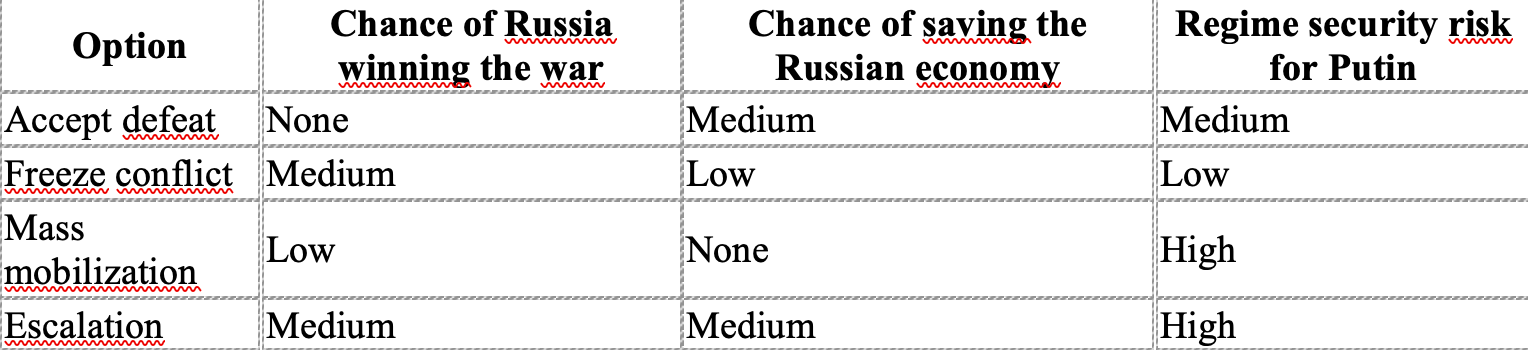
I've identified four basic ways that he can go, and I'm going to measure those on three different parameters that I think are the most important for Putin to consider. The first is whether this given option gives Russia a chance of actually winning the war. The second is what it will do to the Russian economy. And the last one is how big the regime security risk is for Putin. So that is, how much does this undermine Putin's legitimacy as the leader of Russia? And does it increase the risk of him losing power in the coming years, whether by revolution or a coup or by other means?
The first option Putin has is, of course, that he can accept that Russia is never going to achieve the military goals of the special military operation. So essentially acknowledging the defeat. He can change his attitude toward negotiations with Ukraine and accept a deal that basically have the terms that are very close to what the Ukrainians are demanding in the peace negotiations.
If we plot this into the matrix, we can see that this gives Russia basically no chance of winning the war. And when I say that, it's very important to understand that the fact that Russia has taken territory from Ukraine since 2022 does not in any way mean that ending the war right now would constitute any kind of victory.
In fact, the Russian war aims were from the beginning to gain total political control over all of Ukraine. It was never the goal to take territory. So it was the goal to gain political control, which would not be achieved if they accept defeat at this point.
It's also very important to understand that since 2022, when they formally annexed four oblasts in Ukraine, that changed the perspective from a Russian point of view. The war today is, from the Russian perspective, not actually taking place in Ukraine, but it's taking place on Russian territory that is occupied by Ukraine. So that's the kind of legal logic that the Russians apply when they look at the frontline.
So if the war ends along the current frontline, then from Putin's perspective, that would mean that Russia is actually giving up territory to Ukraine in order to end the war and that part of Russian territory would remain under foreign occupation. So this is by no means a victory. It's a clear defeat.
It might, however, save the Russian economy. The biggest problem for the Russian economy is the war, which keeps draining resources and forces the government to keep spending money that they don't have. So ending the war is a prerequisite for beginning to do things that over time can improve the Russian economy.
Overall, I think choosing this option would involve a medium regime security risk for Putin. In the short term, I think he would probably get away with it without the Russians protesting because most Russians today actually do indicate that they would like the special military operation to come to an end. But in the medium term, it would be problematic for him. Everyone would be able to see that Russia had lost the war. There would be significant questions about whether it was worth it.
There is also the big issue of what you do with all the veterans that are going to be returning home when the war ends. They would come home deeply traumatized, and somehow they would need to be reintegrated into Russian society, and that will likely create huge social problems in that process.
Also, although this option might make it possible to save the Russian economy in the long term, it's still going to be really rough in the coming years, even if the war stops now. So overall, ending the war without a clear victory will significantly undermine Putin's legitimacy as the leader of Russia. And there is a real potential that it could lead him to lose power in the coming years.
The next option that Putin has is that he can try to freeze the conflict. The reason the Russian army is losing more soldiers than they can recruit right now is that they insist on staying on the offensive and keep attacking. If they stop doing that, then it might suddenly solve their manning problem, and the war could become sustainable again.
The problem with that, of course, is that in order to achieve its war aims, the Russian army basically has to advance because they haven't achieved their war aims yet. They need to take more territory. So if they stop attacking and instead focus on simply freezing the front line, that would mean that Russia has no chance of winning the war in the near future.
The difference between this option and the one about accepting defeat is that in this situation, the war doesn't actually stop. There will still be fighting and the long-range strikes on Ukraine can continue as can Ukraine, of course, keep striking Russia. The only difference is that the Russians would stop trying to advance on the front line, which would mean that they'd stop taking such heavy losses because they wouldn't keep sending infantry into the Ukrainian drone wall.
This option of freezing the front line could perhaps also be combined with Russia accepting Zelensky's offer of an energy ceasefire. That would mean that Ukraine would stop striking Russian oil refineries. Russia would also have to stop striking Ukrainian energy infrastructure, but they could keep striking everything else.
I actually think that the prospect of freezing the conflict might be the most toxic outcome for Ukraine because it would essentially turn the war into a forever war with no prospect of ever ending. If Russia stops advancing on the front line and agrees to an energy ceasefire, that would totally disrupt Ukraine's war strategy because taking advantage of Russia's willingness to be on the offensive on the front line, and hitting Russian energy infrastructure in the rear are basically the two core pillars of Ukraine's strategy for how they see themselves winning the war.
So freezing the war is not going to lead to a military victory in the short term, but it might create some conditions that could seriously challenge the governability of Ukraine in the longer term. So I'm going to be a little bold here and say that this option actually gives Russia a medium chance of winning the war.
However, this also means that the war would continue to be quite intensive and demand a very large portion of the resources that the Russian state has. So this solution won't offer much hope for saving the Russian economy.
In terms of regime security risk, I think it's pretty low for this option. Actually, the war will continue and Putin can use this both to say that the war is not lost and also to justify all kinds of necessary repressions. He also does not have to bring the soldiers home from the front line because the war is still ongoing. The economy is still bad, but I think he might be able to deal with that in different ways so that it doesn't turn into too much of a regime security problem.
The third option Putin has is that he can go for mass mobilization. The advantage of this option is that Russia can essentially maintain its current military strategy, which is to keep attacking until it eventually gains control of all the territory it claims is Russian. So it's a convenient option in the sense that the Russian leadership doesn't actually have to change its approach and they don't have to acknowledge that the approach so far has been wrong.
The problem with it is that it's hard to see how going for mass mobilization is really going to fundamentally change the dynamics of the war compared to what they already are today. Ukraine is still growing its drone production, and that doesn't really change just because Russia throws more infantry at the drone wall. So going for this mass mobilization option is essentially just going to prolong the pain.
It's hard to see how it would give Russia the resources to change the overall direction of the war, and that's why I'm going to set the chance of Russia winning the war with this option as low.
Going for mass mobilization will also give no chance of saving the Russian economy. In fact, it would be a total catastrophe for the Russian economy because you would be pulling all these people out of the workforce and increasing the resource strain at the front line when you throw even more people into the fight.
Overall, I think the mass mobilization option involves a high regime security risk for Putin. If you want a deeper explanation of that, I recently released a video about the question of when Russians will start protesting, but the short version is that going for mass mobilization is exactly the type of thing that can lead Russians to start pushing back because it would be the state trying to impose changes to the Russian society in a way that directly challenges the coping mechanisms that people rely on in their daily lives. In fact, It's hard to think of anything more invasive in people's personal lives than the state telling you or your husband that they have to go to war.
So overall, the mass mobilization option is pretty bad for Putin because it doesn't really have many advantages, but it carries a very high risk.
The last option Putin has is to try to do something dramatic and fundamentally change the dynamics of the situation and set a whole new direction for the war. This is where he tries to address the root causes of Russia's problems, which essentially is that the European countries keep providing financial support to Ukraine. If the European countries would just stop doing that, then Ukraine's war economy would collapse pretty quickly and Russia would win the war.
So this escalation scenario means that Putin directly threatens NATO in a way that diverts resources away from Ukraine and into defending NATO itself, or that it scares the European countries so much that they decide it's not worth it and that they need to let Russia win in Ukraine because the alternative would be that they themselves would be involved in a war against Russia.
There are many ways this could play out, but one example could be a limited Russian attack on the Baltic states. Those who think that Russia does not have the resources to do that, they're simply wrong. Russia has plenty of resources to allocate a couple of divisions to an attack on one of the Baltic states, if that's what they want to do. That would be plenty to put massive pressure on NATO and to scare the European populations into thinking that we're just two steps away from World War III.
Doing this would be a massive gamble by Putin because there is no guarantee that it would work. But if we put it into the matrix, I'd say there is maybe a medium chance of it actually winning the war for Russia. It might work. I think it's very difficult to predict how Western countries would react to this situation, but there is definitely a possibility that some governments in Western Europe are going to decide that it's not worth it and that they have to stop supporting Ukraine in order to appease Russia.
There's also, I think, a pretty good chance of this saving the Russian economy because if it can actually end the war in Ukraine on terms that are favorable for Russia, then it might also make it possible to do things that will save the economy. So I'm going to put the chance of saving the Russian economy at medium.
But it would be a gamble. It's far from guaranteed that the rest of the European countries would react the way that Putin hopes. And it's quite possible that it could also have the opposite effect with Europeans doubling down on their support for Ukraine. That would leave Russia in a worse situation than before Putin decided to escalate this war.
So I'm going to put the regime security risk for Putin at high in this scenario. If it doesn't work out for him, I think it's pretty safe to assume that this would be the end of his time in power in Russia.
So those are the four basic options that I see Putin having, and which one he's going to choose, I don't know. But I can, of course, speculate about it.
I think it's unlikely that Putin is going to accept defeat. It's just too risky in the medium to long term, and it doesn't really achieve the political goals that Putin has with the war. And we need to understand that this great power project thing that he's going on, in his mind, it's a kind of divine mission about Russia's place in the world. So it's unlikely that he's just going to give up on that.
Of the other options, the most dangerous one is obviously the escalation scenario where Putin triggers a military confrontation with NATO. From Putin's perspective, this option has the advantage of being the only one that offers a significant chance of winning the war quickly.
It addresses the root causes of Russia's predicament, namely that Western Europe is willing to keep funding Ukraine's war. And because it aims at ending the war quickly, it also offers the prospect of saving the economy. So it's a high risk gamble, but it's one with potentially a big reward.
If I were to say what I think would be the smartest choice for Putin, I would say it's probably to try to freeze the conflict. I think that's his best option. And the reason I say that is that I think a frozen perpetual war is the most toxic sort of outcome for Ukraine in the long run.
Whenever I say something like that, I'm going to get comments where people say, "oh, for heaven's sake, don't tell Putin what the smartest thing to do would be because he just might do it". But don't worry, Putin is not listening to me. If there's anything we can take away from the last five years, it's that Putin consistently seems to be doing things that are the opposite of what I think would be smart.
So if anyone asks me what I think Putin is most likely to do, I would actually say that I think the most likely thing is that he will go for another wave of mobilization. I think there is a pretty good chance that his generals are going to convince him that if he just gives them another three or four or 500,000 troops, they can solve the problem. And as you can see from the matrix, that's actually the solution I think is the stupidest one of them all. But I also think it's the one Putin is most likely to choose.
So we can argue about these different options and what variations there can be and what we think Putin is going to do. And I could have made an entire video about each of them, but I just wanted to give a quick overview.
I think the most important thing to take away from this is that the current situation is unsustainable and Putin will have to do something. So we need to start thinking about what that might be, and I think whatever he does, it's going to be something that speaks to one of the options that I've described in this video.
And that also means from a Western European point of view that we need to be prepared for the possibility that he might choose the most dangerous option. We might be heading into a military confrontation with Russia in the final phases of the war in Ukraine. And with all the uncertainty surrounding the United States and NATO, Europe needs to be ready to handle that situation on its own.
Sponsored segment
But the military is not the only area where Europe needs to learn to stand on its own feet. Another area is digital sovereignty and gaining independence from American tech giants. And that's where this video's sponsor Proton comes into the picture.
I use Proton Mail myself because I want my email to be hosted by a European service that is both secure and private. Proton has very high standards for those things, including zero access encryption. So not even Proton can read what's in your inbox. But in addition to that, it also just works very well. I think that's an important aspect as well. Tools that provide privacy and security also need to be easy to use and reliable so people will actually use them. Proton Mail is all of those things.
Changing email providers can sometimes be a daunting task. That's why Proton has created migration tools to make it as easy as possible. you can move your emails, your contacts, your calendars from other providers such as Google in just a few clicks and it just takes a few minutes
If you want to try Proton Mail and support the mission of moving Europe toward greater digital sovereignty, you can get started for free. Proton has a very generous free tier and most people will probably never need to upgrade to the paid plans. So they are really trying to make it as easy as possible to choose the European alternative to big tech. If you want to check out Proton Mail, you can click the link in the video description.
And with that, I will say thank you very much for watching and I will see you again next time.